
At the Intersection of Fashion and Beauty
Are Designer Cosmetics More than Just an Accessory?
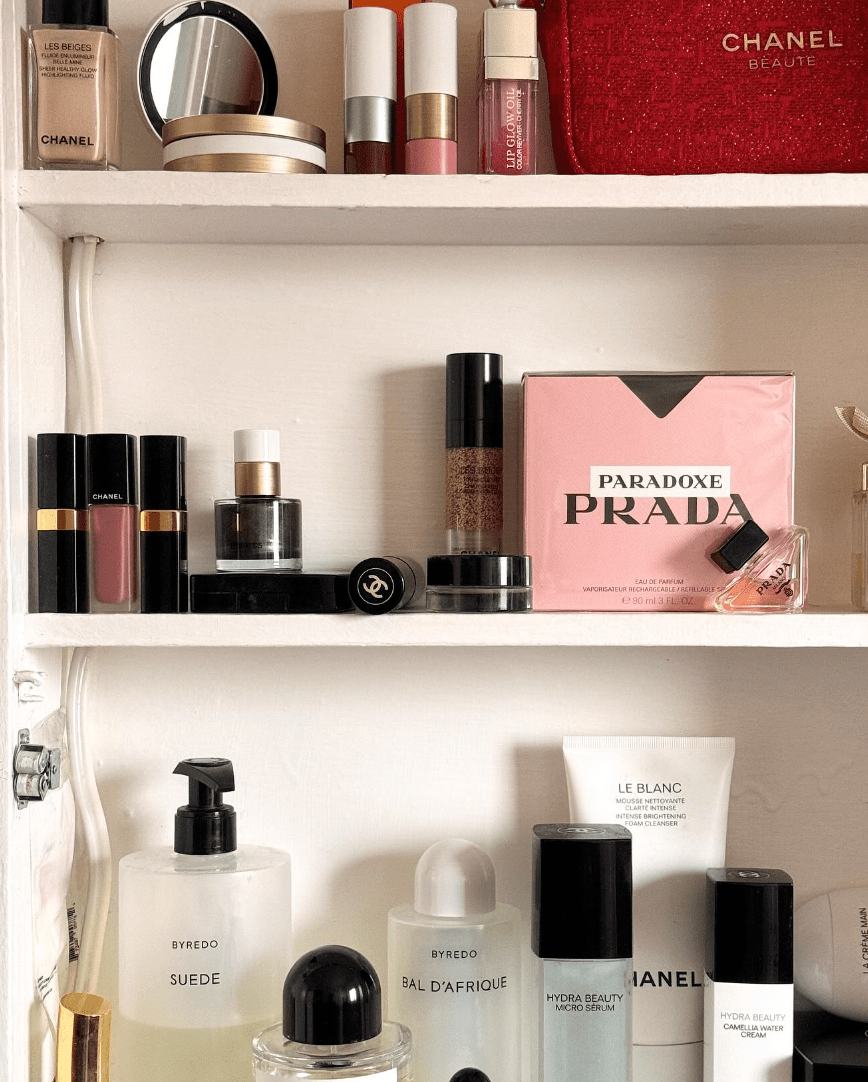
Consisting of sleek chromatic exteriors embossed with the brand’s signature triangular motif, Prada Beauty’s January launch marks the brand’s first foray into the beauty industry. Their color cosmetics line — lipsticks, eyeshadow compacts, and a foundation — is marketed as an avante-garde approach to beauty driven by the company’s focus on the intersection between technology and creativity. Whether or not Prada’s makeup inspires innovation is up for debate, as the brand is by no means the first of its kind to propagate a cosmetic line.
Beauty has become increasingly common in the product portfolios of luxury houses, the likes of Dior, Chanel, and YSL have long relied on makeup, skincare, and fragrance as means of maintaining bottom lines and attracting new demographics. The popularity of luxury cosmetics is perhaps best exemplified by the rise of Dior’s cult-favorite lip glow and lip oil during the pandemic. These lip products, distinguishable by their distinct applicator and lauded for their novel feel, were constantly sold out at beauty retailers like Sephora and Nordstrom. Despite a hefty $40 price point relative to drugstore and high-end counterparts, the lip glow/oil still manages to feel reasonable against the $4000 price tag of a Dior saddle bag. Amongst ranges of often prohibitively expensive clothing pieces and accessories, cosmetics stand out as a more accessible brand extension for widespread customer participation.

The desirability of a luxury makeup product is twofold for customers — they not only decorate the face but also allow for a taste of an elusive lifestyle. Despite the claims of online virality, I doubt even the most seasoned MUA could discern the use of Elf’s loose powder from Givenchy’s. Nevertheless, whether brand identity is present in the product’s packaging or even in its function, the designer lipstick inside of one’s makeup bag provides a sense of ownership.
Although fashion houses are certainly capable of producing quality color cosmetics, beauty lines can easily become a cash grab. During the holiday season last year, Dior Beauty launched its “Rouge Dior Minaudière Clutch”, a $300 set of three mini and one full-size lipsticks. The item’s selling point, which was quickly picked up on TikTok, was its metal clutch-like case complete with an attachable chain. Users extolled the item’s dual function and advertised it as a hack for obtaining an authentic $300 Dior bag. In reality, the so-called Dior “clutch” was merely a cheap plastic box stamped with a CD logo. The frenzy it created, however, speaks to the public’s desire to have a piece of the luxury pie. In searching for the most affordable deal, the existence of luxury fashion as an epicenter of design and quality is rendered null. Rather than valuing the characteristics that justify a high price, consumers increasingly perceive certain brand names as a means of flexing wealth and signaling status. This fixation with brand names makes the proliferation of more inexpensive products (beauty & fragrance) highly profitable for fashion brands looking to diversify their offerings.
While some brands wield cosmetics lines as secondary streams of income, others are more in tune with how beauty can extend a more comprehensive lifestyle experience to their customer. Makeup is often the first step of a morning routine, and skincare closes out a nighttime regimen — there is significance in this day-to-day embeddedness. The relationship between price and quality or prestige and efficacy is not linear when it comes to luxury beauty because it doesn’t need to be.
Reach column writer Sarah Yu at musemediauw@gmail.com
Instagram @_sarahyu


 Muse Media UW